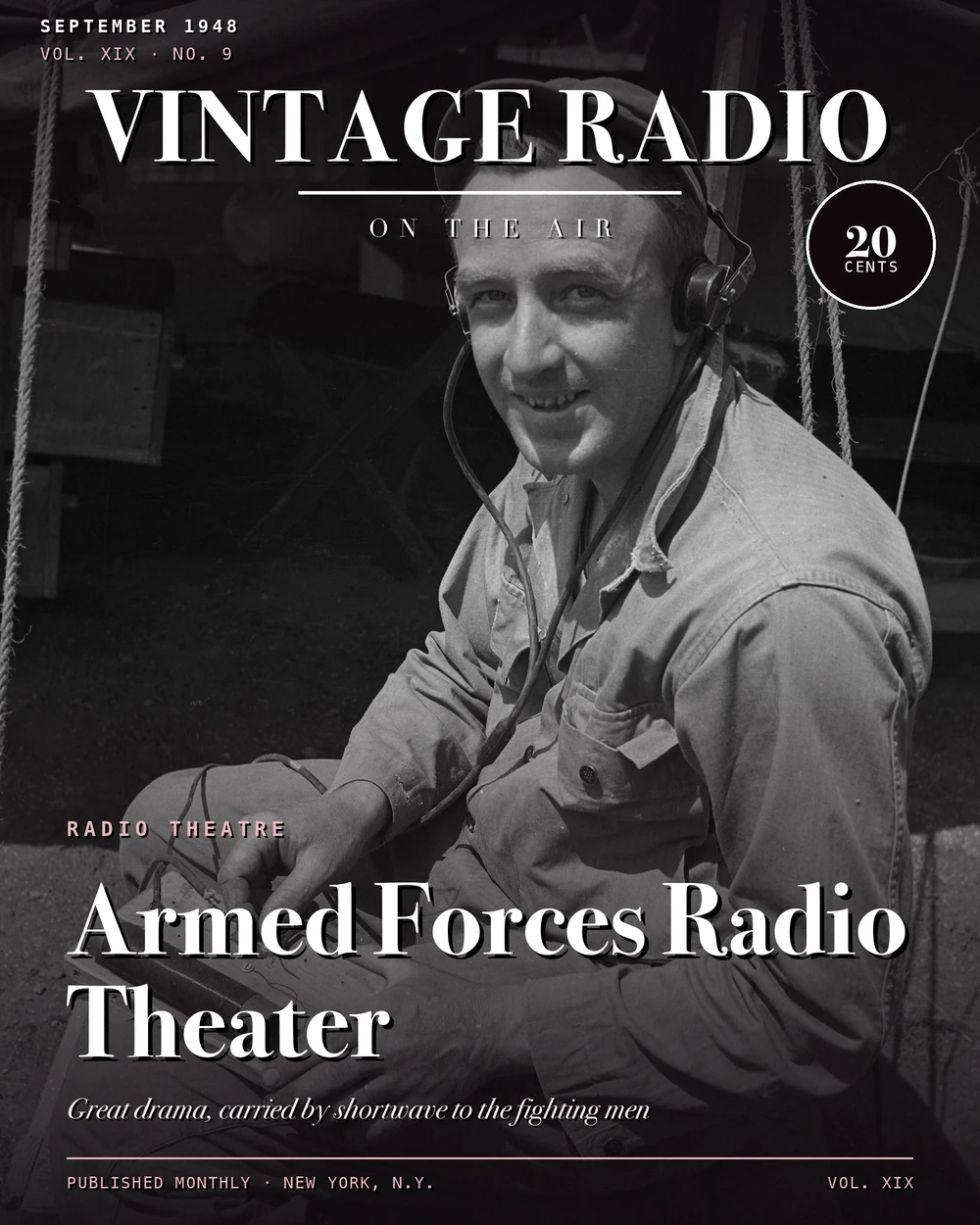
Armed Forces Radio Theater
The Organization Behind It
The Armed Forces Radio Service was formally established by the War Department on May 26, 1942, with its production operation anchored at 6011 Santa Monica Boulevard in Los Angeles. Its mission was straightforward: get quality entertainment to American service members stationed around the world. Historian Erik Barnouw described the resulting network as "global and without precedent," noting that in the pre-television era a concentrated effort was made to keep radio broadcasting going for troops in both the European and Pacific theatres.
The man running the operation, AFRS commandant Colonel Thomas H. A. Lewis, had been a vice-president at a Hollywood advertising agency before the war and was married to actress Loretta Young. Those connections opened doors. Major Hollywood talent came through voluntarily, and the AFRS also drew on commercial network programming that had been "decommercialized" — edited to strip out sponsor mentions, sometimes retitled, and then distributed to military broadcasters. Programs went out on transcription discs rather than shortwave because disc guaranteed consistent audio quality regardless of where in the world the broadcast was landing.
Among the writers working on AFRS productions were Sergeants Jerome Lawrence and Robert E. Lee, who went on after the war to co-author Inherit the Wind and Auntie Mame on Broadway. Lawrence and Lee are credited as co-founders of the AFRS production operation in Los Angeles, and both later donated materials to the New York Public Library's Rodgers and Hammerstein Archives, which holds an AFRS collection of broadcast recordings from 1942 to 1949, including transcription discs of programs such as Globe Theater, Mail Call, Command Performance, and Yarns for Yanks.
What the Show Was
Armed Forces Radio Theater ran from August 25, 1945, through October 23, 1946 — a relatively short run that began in the final weeks of World War II and continued into the early postwar period. Episodes ran approximately thirty minutes. The program drew on dramatic adaptations of popular films, original plays, and material from literature, with content built around the lives and concerns of service members and morale as the explicit goal.
The known episode roster gives a sense of the range. Return to Tomorrow starred Dane Clark; Johnny Cartwright's Camera featured Olan Soule; Shadow of a Doubt brought in Joseph Cotten and Jeff Chandler; The Private Eye starred George Raft. These titles and cast credits come from the 1986 Pitts radio soundtracks reference guide, which lists them as sample segments of the series. The show was noted for high production standards and for drawing prominent actors and writers of the period.
What Survives
Three episodes are held in the catalog: Return to Tomorrow, The Devil and Miss Jones, and Johnny Cartwright's Camera. The Pitts guide documents Shadow of a Doubt and The Private Eye as known broadcasts beyond those three. The overall episode count for the series is not established by the available record — the catalog represents a slice of what was produced across the run.
The AFRS itself continued operating after the war ended and was later restructured as the Armed Forces Radio and Television Service. Its technical methods also left a mark: the disc-editing process developed at AFRS — cutting between glass and vinylite transcription discs to assemble finished programs — became, in Barnouw's phrase, "a highly developed specialty at AFRS" and later influenced how commercial radio adopted transcribed broadcasting more broadly. Armed Forces Radio Theater sits within that larger story, a drama program aimed at a specific audience at a specific moment, produced by an organization that was quietly inventing some of the infrastructure modern broadcasting would come to rely on.